TL;DR
- Corporate video production covers everything from brand films and training videos to testimonials and event coverage, and 91% of businesses now treat video as a core part of their marketing mix.
- A typical project moves through three stages, pre-production, production and post-production, and takes roughly four to eight weeks from brief to final cut.
- UK pricing usually falls into three bands: a half-day shoot from around £1,000, a full production day from around £2,499, and a two-day premium shoot from around £4,999 and up, though scope always moves the number.
- Choosing between an in-house team, a freelancer and a specialist corporate video production company comes down to volume, complexity, and how much creative control you want to keep.
What Is Corporate Video Production?
Corporate video production is the process of planning, filming and editing video content that represents a business to its employees, customers, partners or investors, rather than selling a single consumer product. It's the umbrella term for everything from a two-minute “who we are” film on a homepage to a ten-part internal training series nobody outside HR will ever see.
That distinction matters more than it sounds. A consumer ad has one job: sell this thing, right now. A corporate video usually has to do something quieter and longer-lasting, build trust, explain a process, onboard a new hire, or convince an investor that the leadership team knows what it's doing. The brief changes. The tone changes. Even the way you measure success changes, watch time and completion rate matter more here than click-through rate.
In practice, “corporate video production” gets used as shorthand for a handful of distinct formats: company overview films, culture and recruitment content, product or service explainers aimed at other businesses, training and induction material, testimonials, and event coverage. A specialist corporate video production service will usually offer most of these under one roof, because the underlying skills (scripting, interviewing, lighting, editing to a brand voice) transfer across all of them.
Why Corporate Video Production Matters in 2026
Video has stopped being a nice-to-have marketing line item. 91% of businesses now use video as a core marketing tool, and 82% of marketers say it delivers a genuinely good return. Companies using video consistently report growing revenue faster than those that don't, and the gap isn't marginal.
The numbers get sharper once you look at conversion specifically. Landing pages that include video can see conversion rates climb as high as 4.8%, against roughly 2.9% for pages without it, a lift worth chasing for anyone running paid campaigns or a careers page that isn't converting. None of this is new information to a marketing team, but the scale of it keeps surprising people who last checked these figures five years ago.
What has changed is format. Short-form is winning: 71% of marketers say the 30-second-to-2-minute window is the sweet spot, and anything under 60 seconds now gets the strongest engagement per impression of any content type. That's a real shift for corporate video specifically, because the instinct has always been to make the company film longer to “cover everything.” The data says the opposite. Say less, say it better, and let a longer version live on the website for the people who actually want the detail.
Types of Corporate Video Production
Not every business needs the same video. A recruitment-heavy scale-up and a manufacturing firm with a training compliance problem are solving completely different problems, even though both might call it “corporate video.”
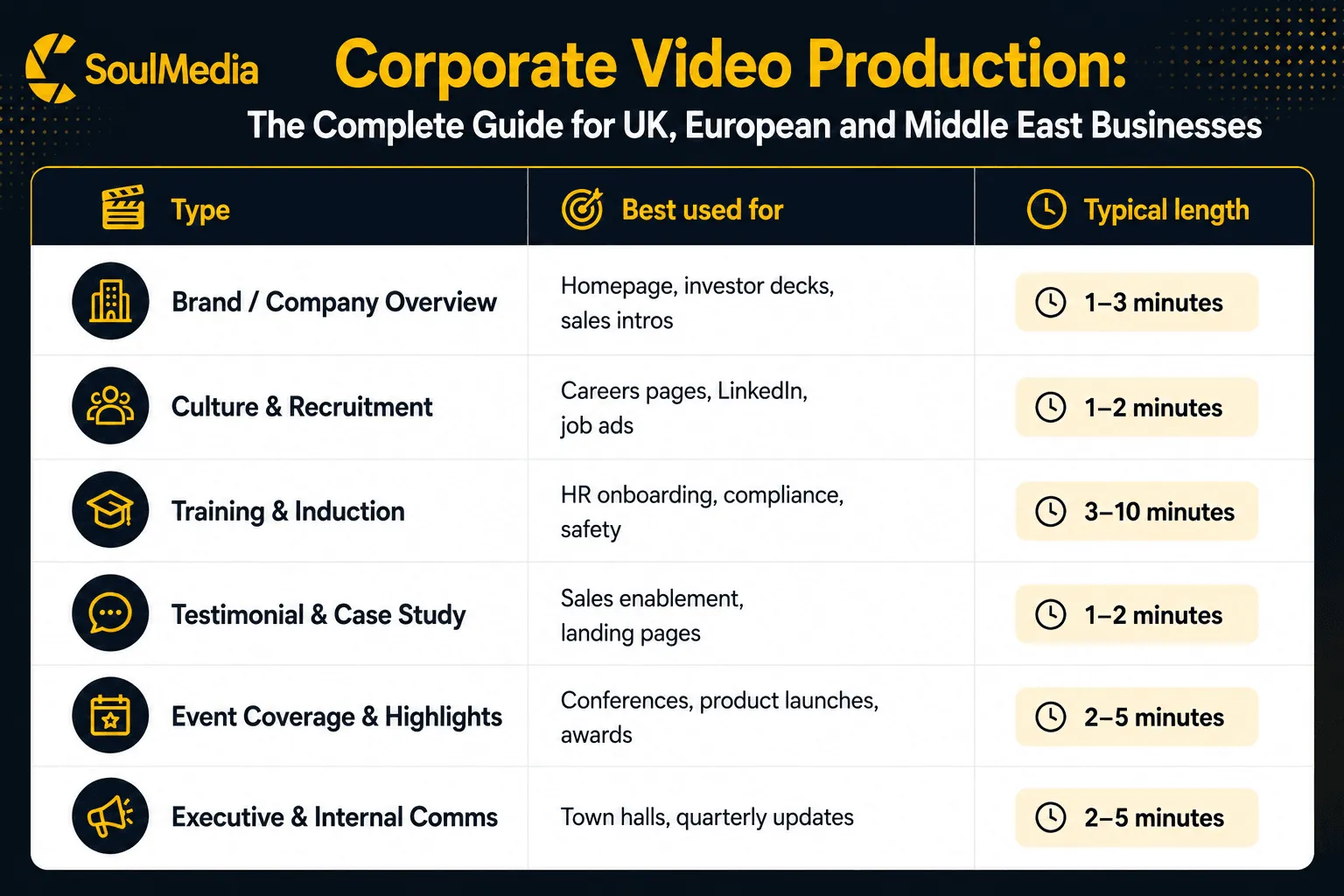
A few of these are worth calling out specifically. Event coverage has its own logistics problem entirely, multiple cameras, unpredictable lighting, no second takes, and SoulMedia's approach to filming live events covers why that discipline needs its own playbook rather than a scaled-down version of a studio shoot. If your priority is ongoing social content rather than a single set-piece film, that's a different service line again, closer to brand storytelling and social content production than a one-off corporate video.
The Corporate Video Production Process
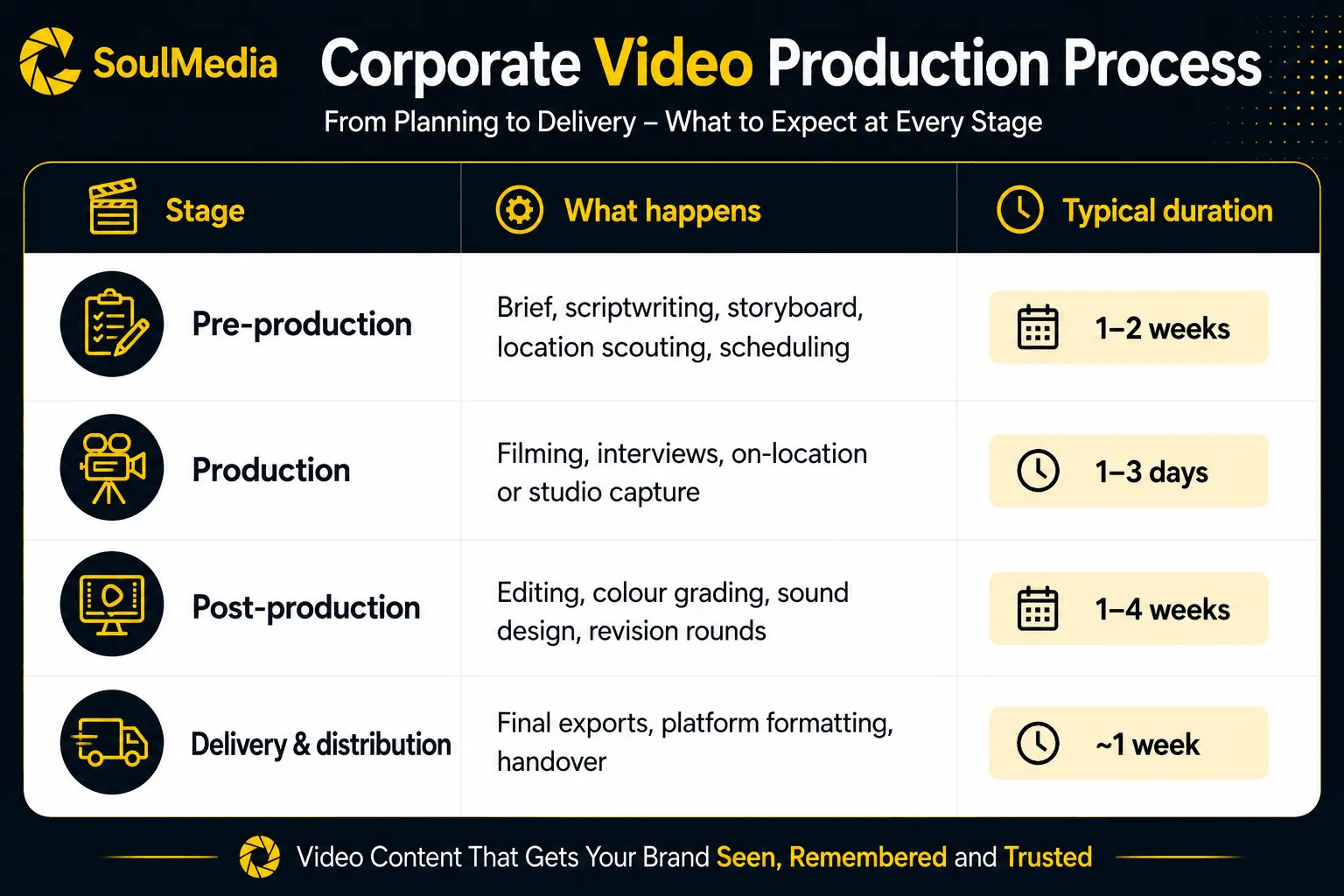
Every serious corporate video production project runs through the same three stages, pre-production, production and post-production, even when the finished film is only ninety seconds long. The planning is where the real work happens; the filming day is often the shortest part of the whole timeline.
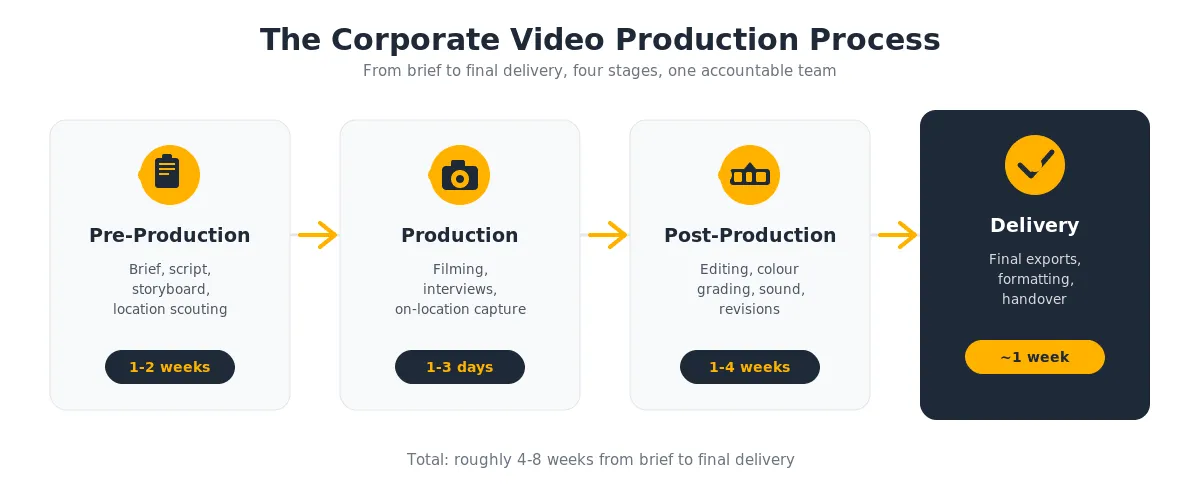
Add it up and most projects land somewhere between four and eight weeks from first brief to final file, longer if the script needs several rounds of internal sign-off, which it almost always does when more than two stakeholders are involved. Anyone promising a finished corporate film in a week is either doing something very small or cutting a corner you'll notice later, usually in the audio.
How Much Does Corporate Video Production Cost in the UK?
UK corporate video pricing typically splits into three tiers, and the honest answer to “how much will this cost” is “it depends on locations, revisions and shoot length,” but here's what that looks like in practice.
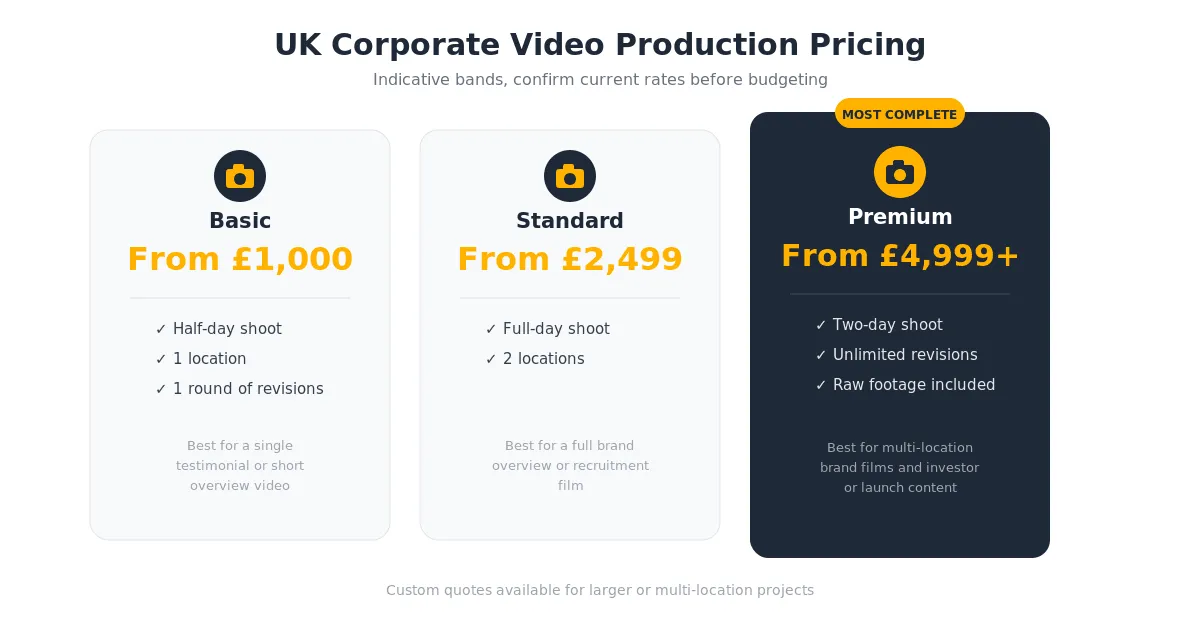
These bands (drawn from SoulMedia's corporate video production service, correct at time of writing, always worth confirming current rates before you budget against them) track fairly closely with what's typical across the UK market. The variables that move the number most are the number of locations, whether you need original music or licensed tracks, how many people need to be interviewed, and how many revision rounds are baked into the quote versus billed separately. A testimonial video shot in a single afternoon at a client's office costs a fraction of a two-day multi-location brand film with drone footage and a voiceover artist, even though both get called “corporate video.”
In-House vs Agency vs Freelancer: Choosing Your Production Partner
There's no universally right answer here, only a right answer for your volume and your ambition. A business making one film a year for its annual report has different needs to one publishing weekly LinkedIn video.
Filming everything in-house on a phone works for quick, disposable social clips where authenticity beats polish. It breaks down fast once you need proper lighting, a script that doesn't ramble, or footage that will still look acceptable in three years.
A freelancer sits in the middle: usually cheaper than an agency, capable of strong work, but a single point of failure if they're ill on shoot day or don't own the gear a bigger project needs. A dedicated corporate video production company brings a full crew, backup equipment, and the project management to keep a two-location shoot with six stakeholders from falling apart. The practical questions worth asking before you pick a lane:
- How many videos do you actually need this year, one, or twelve?
- Does the footage need to survive a rebrand or a leadership change without looking dated?
- Do you have someone internally who can write a script that isn't just the mission statement read aloud?
- Is there a hard deadline (an investor day, a conference) where a no-show crew isn't an option?
- If the answer to most of those points toward “this needs to be right, not just done,” that's usually the signal to bring in a specialist rather than stretch an in-house resource that has a day job already.
How to Brief a Corporate Video Production Company
A weak brief is the single biggest cause of a corporate video that misses the mark, so it's worth getting right before you contact anyone. A good brief tells a production company what the video needs to achieve, who it's for, and what “good” looks like, not just “make us a company video.”
At minimum, that means naming a single primary objective (recruit better candidates, support a sales pitch, explain a process to new starters) rather than several at once. Trying to serve five audiences in one three-minute film is how you end up with something that serves none of them well. It also means being specific about where the video will live: a version optimised for a homepage hero banner is cut differently to one built for a LinkedIn feed or an internal intranet page, even if the underlying footage is the same.
Tone matters as much as content. Sending a production company two or three examples of videos you like (and, just as usefully, one you don't) does more to align expectations than a page of adjectives like “professional” and “dynamic,” which mean something different to everyone in the room. Finally, agree revision rounds and sign-off stages upfront. Nothing stalls a project faster than discovering, three edits in, that a stakeholder who was never in the loop suddenly wants changes nobody budgeted time for.
Corporate Video Production Trends to Watch in 2026
A few shifts are worth planning around rather than reacting to later. Personalisation is replacing the one-size-fits-all company film. Instead of a single overview video for every audience, brands are producing tailored cuts, different voiceovers, different opening hooks, sometimes different footage entirely, depending on whether the viewer is a prospective hire, a customer, or an investor.
AI tools have moved from novelty to normal. 63% of video marketers now use AI tools somewhere in their creation or editing workflow, mostly for rough cuts, transcription and captioning rather than replacing a director's judgment. It's a productivity tool, not a substitute for a real script.
Immersive and 360-degree formats are growing in training contexts specifically. Manufacturing and logistics businesses are using 360 video for facility walkthroughs and safety induction, where letting a new starter “look around” a hazardous environment before they set foot in it has genuine value; the HSE's guidance on effective workplace induction and training is a useful benchmark for what that content actually needs to cover, beyond just looking impressive.
Short-form is not going away. The 30-second-to-2-minute window keeps winning attention, which means longer corporate films increasingly get built as a “hub” video with multiple short cutdowns for social, rather than one asset trying to do every job at once.
Which Industries and Audiences This Applies To
Corporate video production isn't one-size-fits-all by sector either. Professional services firms, law, accountancy, financial advice, lean heavily on trust-building content: leadership interviews, client testimonials, and explainer content that makes complex advice feel accessible. Technology and SaaS companies tend to need the opposite pairing, sharp product explainers for the sales team and culture content for recruitment in a competitive hiring market.
Manufacturing and logistics businesses have a different problem entirely: training, induction and safety communication, often for a workforce that isn't sitting at a desk reading a handbook. That's where the 360-degree and immersive formats mentioned above earn their cost.
Event and conference organisers need coverage that can turn a single day into months of highlight and social content. Charities and NGOs use corporate-style video for donor storytelling in a register that's warmer than a typical B2B explainer but structurally similar. And small and mid-sized businesses across every sector increasingly need a lean, well-produced company overview simply because their competitors already have one and a dated or amateur video now stands out for the wrong reasons.
Final Thoughts
The businesses that get real value from corporate video aren't the ones with the biggest budget, they're the ones who worked out which specific problem the video needs to solve before anyone picked up a camera. A recruitment video and a training video are not the same brief wearing a different label, and treating them that way is how companies end up with a film nobody watches past the first fifteen seconds. If you're weighing up whether this year's project needs an in-house shortcut or a proper production partner, the honest test is simple: will this video still look right in eighteen months, and does the deadline it's tied to actually allow for a rushed job. If either answer makes you wince, it's worth getting a proper quote before committing to the cheaper option.