Interview Video Production: What It Costs and How It's Made
TL;DR:
- Interview video production is the process of filming spokespeople, executives, employees or experts answering questions on camera to build trust, explain ideas or promote a brand, and it ranges from a single-location leadership interview to a multi-city panel series.
- Costs in the UK typically run from around £800 for a simple single-location interview to £5,000+ for a multi-location production with custom motion graphics; the format you choose (leadership, panel, podcast-style, thought leadership, documentary-style) drives the price more than anything else.
- The videos that actually get watched share three things: an interviewee who was properly briefed beforehand, audio that was treated as seriously as the picture, and a distribution plan decided before the cameras were booked.
- This guide covers formats, real cost ranges, the filming process, how to prepare a nervous spokesperson, and where interview video earns its place in a wider content strategy, so you can brief a production company (or your own team) without guessing.
Ask a marketing manager what "interview video" means and you'll get three different answers in the same meeting. One person means a two-camera sit-down with the CEO. Another means a podcast-style conversation for LinkedIn. A third means something closer to a documentary, where the interview is the spine and everything else, B-roll, graphics, archive, hangs off it.
They're all right. That's the problem. Interview video production is a broad category, and most of the guidance online treats it as one thing: point two cameras at a person, ask questions, cut it together. In practice, the format you pick decides your budget, your crew size, your editing timeline and whether the finished video actually gets watched past the first fifteen seconds.
This guide breaks the category down properly: what each format is for, what it costs in the UK market in 2026, how a professional shoot actually runs, and the parts nobody tells you about, like how to stop a nervous spokesperson from freezing the moment the camera light comes on.
What Is Interview Video Production?
Interview video production is the process of filming one or more people answering questions on camera, then editing that footage into a finished video used for marketing, internal communication, recruitment or PR. It differs from a testimonial video, which centres on a customer validating a product, and from a documentary, where the interview is one ingredient among several rather than the whole meal.
The category sits underneath a few different business goals at once. A corporate comms team might use it to put a face to a strategy announcement. An HR team might use it to show what it's actually like to work somewhere. A PR team might use it to get an executive's perspective in front of journalists or industry press. The mechanics of filming are similar across all three; the questions, the framing and the distribution plan are not.
What ties the category together is the format itself: a person, a question, an honest answer, captured well enough that a stranger watching on a phone screen believes what they're hearing. That's a harder brief than it sounds, which is why the difference between an amateur interview video and a professional one is rarely the camera. It's almost always the preparation, which is also why the agencies that do this well tend to lead with process rather than equipment lists, including our interview video production service.
Why Interview Video Works (When the Numbers Back It Up)
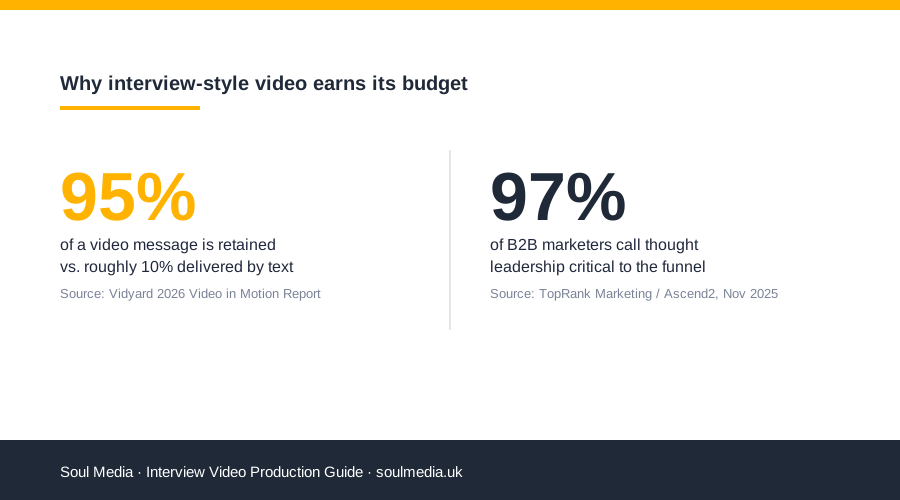
Interview-format video works because buyers and employees trust a real person on camera more than they trust a paragraph of marketing copy, and the data on video generally supports that, even where it doesn't isolate the interview format specifically. Ninety-one percent of businesses now use video as a marketing tool, and 83% of marketers say video has directly increased sales, according to Wyzowl's 2026 video marketing survey. That's a broad claim about video as a category, not interview video specifically, but it establishes the baseline: video is no longer a nice-to-have line item, it's close to the default.
Narrow the lens to how much of a video message actually lands, and the case for the interview format gets more specific. Viewers retain roughly 95% of a message delivered by video, compared to about 10% delivered by text alone, according to Vidyard's 2026 Video in Motion Benchmark Report. That figure comes from Vidyard's broader video-messaging research, not from an interview-specific study, but it points at the same mechanic: an executive explaining a strategy shift on camera tends to land harder than the press-release version of the same message, because people simply remember more of what they watched a real person say than what they read. Interview video isn't identical to a testimonial, but it draws on the same trust mechanic: a real voice, unscripted enough to sound human, saying something a brand couldn't credibly say about itself in a bullet list.
On the thought-leadership side, TopRank Marketing and Ascend2's November 2025 survey of nearly 800 B2B marketers found that 97% consider thought leadership critical to full-funnel success, yet 71% say engagement is harder to earn than it used to be. That gap matters. It's not that thought leadership content stopped working; it's that generic written thought leadership got crowded out, especially as 32% of professionals now report discovering that kind of content through generative AI tools rather than a feed or a search result. A real person's voice and face is harder to reduce to a generic paragraph than a page of unattributed marketing claims, which is one reason interview-format content tends to hold up as other formats get commoditised.
The Edelman-LinkedIn 2025 B2B Thought Leadership Impact Report adds a structural reason to care: more than 40% of B2B deals stall because of internal misalignment inside the buying group, and the report's "hidden buyer" research found that people outside the obvious decision-maker seat engage with thought leadership just as actively as the named buyer does. An interview video that a champion can forward internally, one that carries a real person's authority rather than a slide deck, is built for exactly that stalled-deal moment.
None of this proves that any single interview video will convert. It shows why the format earns a place in the plan: real, credible voices tend to travel further across a scrolling LinkedIn feed and a stalled internal buying committee than another slide deck does.
Interview Video Formats, and When to Use Each One
Different interview formats solve different problems, and picking the wrong one is the single most common reason a shoot goes over budget or the finished video sits unwatched. The table below is the shortlist worth actually choosing from.
| Format | Best for | Typical crew | Typical length (finished) | Best channels |
|---|---|---|---|---|
| Executive & leadership interview | Strategy announcements, investor updates, annual reports | 2-3 camera, single location | 2-4 minutes | Website, LinkedIn, investor relations |
| Panel & multi-guest interview | Conferences, product launches, expert roundtables | 3-4 camera, multi-mic | 5-15 minutes | Event recap, YouTube, internal comms |
| Podcast & long-form video interview | Thought leadership series, founder content | 2-3 camera, conversational set | 15-45 minutes | LinkedIn, YouTube, owned podcast feed |
| Expert & thought leadership interview | Sales enablement, category education, PR | 2 camera, single location | 3-6 minutes | Sales decks, gated content, press |
| Documentary-style interview | Brand story, culture, recruitment | 2-3 camera plus B-roll days | 4-10 minutes | Careers page, employer branding, awards entries |
A leadership interview and a documentary-style interview both feature someone talking to camera, but they're not interchangeable briefs. A leadership interview is built to be short, quotable and fast to produce, usually inside a single half-day shoot. A documentary-style piece needs B-roll days, more editing time and a script structure that can carry ten minutes without losing the viewer, which is why it costs more and takes longer to deliver.
The mistake we see most often is a client asking for "an interview video" without naming the format, then being surprised when the quote assumes a half-day shoot and the brief actually needed three locations and a week of edits. Naming the format on day one fixes that before it becomes a change order.
How Much Does Interview Video Production Cost in the UK?
A single-location interview video in the UK typically starts from £800 to £1,500, while multi-location shoots, panel formats or anything with custom motion graphics move into fixed-price quote territory, usually £2,500 and up. Two of the biggest names ranking on page one for this exact search, Bold Content Video and Beast Agency, publish no pricing at all on their interview pages; both push every enquiry straight to a contact form. That's a gap worth naming, because it makes budgeting harder than it needs to be for anyone briefing their first shoot.
Here's what a tiered structure actually looks like in practice, using Soul Media's published UK pricing as a real, current reference point:
| Package | Price | Shoot length | Crew | Locations | Revisions | Delivery |
|---|---|---|---|---|---|---|
| Basic | £1,000 | Half-day (4 hrs) | 2-camera | 1 | 1 round | 10 days |
| Standard | £2,499 | Full-day (8 hrs) | 3-camera | 2 | 2 rounds | 10 days |
| Premium | £4,999+ | Two-day | Full camera & art crew | Multiple | Unlimited | 14 days |
Worth flagging: the interview-specific £800 entry point quoted above sits a little below the general Basic package's £1,000, because it's the figure quoted specifically for straightforward single-location interviews rather than the sitewide baseline. Treat £800-£1,500 as the realistic entry range for a simple interview shoot, and the table below as what a full Basic-to-Premium engagement actually includes.
A few things move the price beyond the base package: how many interviewees you're filming (a panel costs more per hour than a single sit-down), whether you need original motion graphics or licensed music versus royalty-free, and whether footage needs adapting into multiple cuts for different channels (a 3-minute website version, a 60-second LinkedIn cut, a 15-second teaser). Ask any production company for a per-deliverable breakdown before signing, not just a headline day rate; that's where scope creep hides.
One thing that varies by project rather than by package: interviewee count, language requirements and travel. These aren't automatically bundled into any tier, they're scoped per project, so confirm them in writing before the shoot rather than assuming they're covered.
The Interview Video Production Process: 6 Steps
A professional interview shoot follows a predictable sequence, and most delivery problems trace back to a step that got skipped, not a step that went wrong.
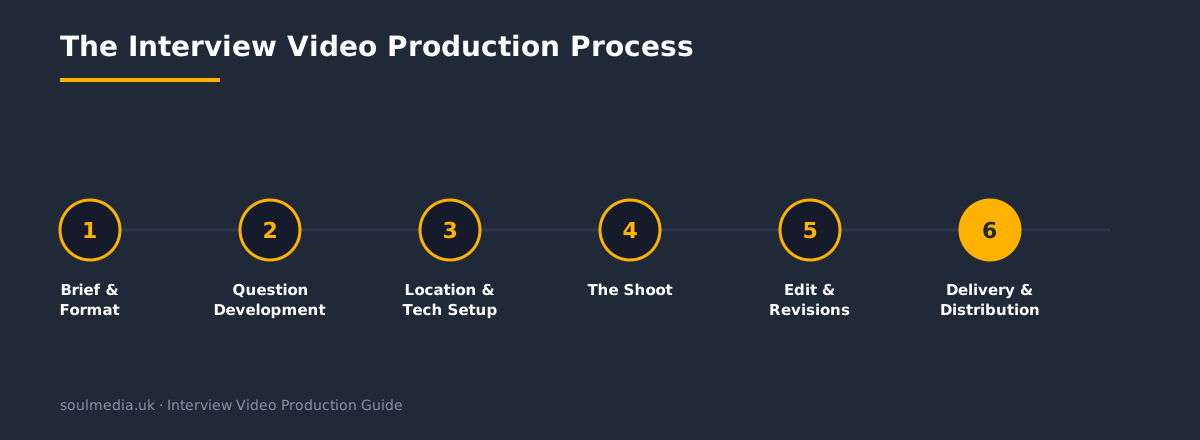
1. Brief and format selection. Before any camera is booked, the production team should ask what the video is for, who's watching it, and where it'll be published, because that determines the format from the table above. A LinkedIn thought-leadership clip and an investor-relations video are not the same brief wearing different clothes.
2. Question development. Good interview questions are built to produce usable answers, not just interesting conversation. That means writing questions that can be answered in a self-contained sentence or two, because editors need clean, quotable soundbites, not fifteen minutes of a person thinking out loud.
3. Location and technical setup. Multi-camera coverage (typically two to four cameras) captures different angles simultaneously so the edit has options: a wide shot, a close-up, a cutaway to the interviewer's reaction. Audio gets its own setup entirely, usually a lapel mic plus a boom or second wireless as backup, because viewers forgive average visuals far more readily than they forgive audio they have to strain to hear.
4. The shoot itself. A single-location interview typically needs about half a day including setup, lighting and a proper briefing conversation before the cameras roll. Panel and multi-location shoots get scoped individually because the variables (travel, multiple lighting setups, coordinating several people's availability) multiply fast.
5. Edit and revisions. This is where the format decision pays off or doesn't. A 3-minute leadership interview might take a few days to cut; a 10-minute documentary-style piece with B-roll integration takes considerably longer. Revision rounds matter here too, one round is rarely enough for anything above a Basic-tier shoot, which is why mid and top-tier packages typically build in two or more.
6. Delivery and distribution. The finished file isn't the end of the job if the video is meant to actually get watched. Delivery should include the aspect ratios and lengths needed for wherever it's going: a 16:9 master for the website, a 1:1 or 9:16 cut for social, captions burned in for silent autoplay. A production company that hands over one file and calls it done has left the hardest part, getting it seen, entirely to you.
How to Prepare a Spokesperson Who's Nervous on Camera
Most people are worse on camera than they are in a normal conversation, and that's not a talent problem, it's a preparation problem. The fix is almost always the same three things, done properly, rather than one clever trick.
First, brief the interviewee on the questions in advance, but don't script the answers. Knowing roughly what's coming lets someone think through their point; memorising a scripted answer makes them sound like they're reciting one, which viewers spot instantly. A useful structure is to share the topics, not the exact wording, and let the person answer in their own language when the camera rolls.
Second, run a genuine warm-up conversation before recording starts, not a countdown. The first two or three minutes on camera are almost always the stiffest; experienced crews record through that stiffness rather than starting the clock the second the person sits down, then use the warmed-up section in the edit. Some production teams go further: one well-documented technique has the interviewer let a nervous subject ask questions back, flipping the dynamic just long enough to break the tension, often resolving it within about fifteen minutes.
Third, direct for conversation, not delivery. Coaching someone to "just be yourself" rarely works on its own; what actually works is an interviewer who reacts like a real listener, nods, follows up, lets a pause sit instead of jumping in, because a spokesperson who feels heard stops performing and starts talking. That's the difference between a video that sounds like a hostage statement and one that sounds like a person you'd trust.
None of this requires a bigger budget. It requires a crew that treats the fifteen minutes before recording as part of the job, not dead time before the "real" shoot starts.
Where Interview Video Fits in Your Content Strategy
A single interview shoot can outlive its original brief if it's planned for reuse from the start, and that's the difference between interview video as a one-off deliverable and interview video as an asset. A 20-minute conversation with a founder can become a 3-minute website piece, a handful of 60-second cuts for a social media video strategy, a written article using the transcript as source material, and audiogram clips for anywhere video autoplay is disabled.
The distribution plan should exist before the shoot, not after the edit, because it changes what you film. If a vertical LinkedIn cut is part of the plan, the crew frames for it during recording rather than trying to reframe a horizontal master afterward and losing half the composition. If sales enablement is a use case, the interviewer asks at least one question designed to produce an answer a sales rep can drop straight into a deck.
The recurring mistake is treating interview video as a single-use asset when the cost structure already assumes reuse. A Standard-tier shoot with two revision rounds and motion graphics is priced for a video that earns its keep across several channels and several months, not one that gets posted once and forgotten.
Which Industries and Audiences This Applies To
Interview video production earns its budget fastest for organisations where a named person's credibility is the actual product, often as one piece of a wider corporate video production plan. Professional services firms (law, accountancy, consulting) use expert interviews to demonstrate expertise that's genuinely hard to fake in writing alone. Technology and SaaS companies lean on founder and customer-facing leadership interviews to put a human face on otherwise abstract products. Financial services and investor relations teams use executive interviews for results announcements and market commentary, where a face and a voice carry more weight with stakeholders than a press release.
HR and talent teams use employee and leadership interviews for recruitment marketing and employer branding, showing candidates what the culture is actually like rather than describing it in a job ad. Events and conference organisers use panel and multi-guest interview formats to extend a single day's content into weeks of recap material. PR and communications teams use expert interviews to get executives camera-ready for press opportunities and to have owned footage ready when a journalist asks for comment.
The common thread across all of these: whenever the credibility of a real person, not a logo or a product shot, is what's actually being sold, interview video tends to earn back its budget faster than almost any other format.
Final Thoughts
The interview video that actually works isn't the one with the best camera or the most expensive lighting kit. It's the one where someone spent fifteen minutes making the interviewee comfortable before recording, wrote questions built for clean answers instead of open-ended chat, and had a distribution plan before the crew ever showed up. Everything else, the format, the crew size, the budget tier, follows from getting those three things right.
If you're weighing up formats for your next shoot, start with the goal rather than the format name: what does the audience need to believe after watching, and where will they actually see it? That answer decides whether you need a two-camera leadership interview or a full documentary-style production, and it's a five-minute conversation worth having before anyone picks up a camera. Get a free quote for your next interview video project, or browse Soul Media's full range of video production services if you're still deciding which format fits your brief.