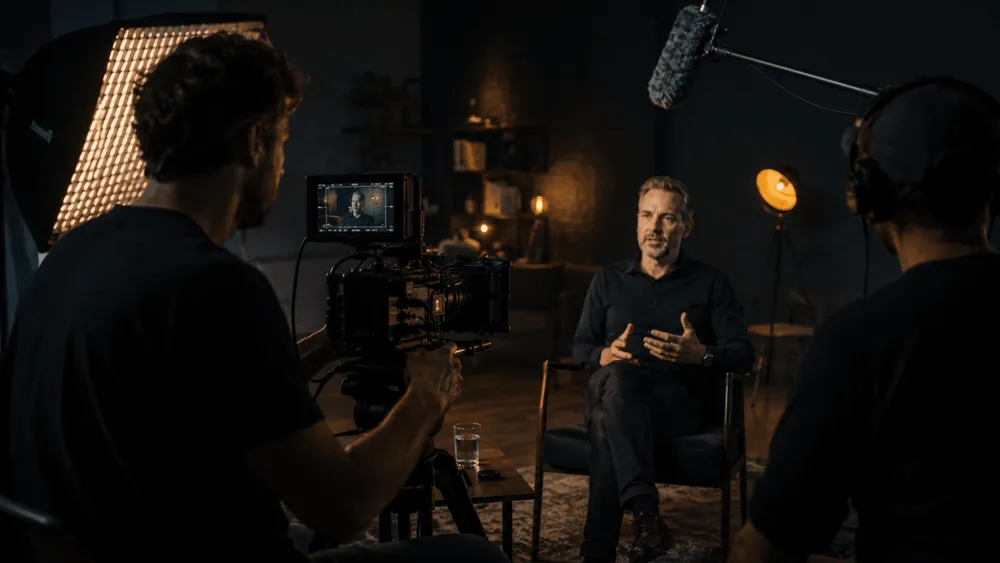
Documentary Film Production Guide
TL;DR:
- Documentary film production turns a real story, about your brand, a cause, a community or your people, into long-form video built on research, interviews, cinematic filming and story-led editing, not a script written to sell.
- In the UK, Soul Media's documentary work starts from £4,999+ for a single-location, single-day project with a full edit; multi-location, multi-day and docu-series projects are quoted individually once the brief is clear.
- Short-form brand documentaries (3-10 minutes) usually take 3-6 weeks from kickoff to final delivery; longer films and docu-series with multiple shoot days can run several months.
- Documentary earns its budget when the story, not the product, is what makes someone stop scrolling. If you just need to explain a product clearly, a corporate video will do the job faster and cheaper.

Most video content asks for eight seconds of attention and a click. Documentary asks for something harder: it asks people to sit still and actually watch. That's a bigger swing, and it only pays off when there's a real story underneath it, not a marketing brief dressed up in b-roll.
This documentary film production guide is written for the person who has to make that call, a marketing lead, a comms manager, a founder, a charity director, deciding whether a documentary is worth commissioning, what it costs in the UK right now, how long it actually takes, and what separates a film people finish watching from one they close after twenty seconds.
What Is Documentary Film Production, Really?
Documentary film production is the process of researching, filming and editing a true story, about a brand, a cause, a community or an individual, into a finished film. It's built on real interviews and real moments rather than a script, which is what gives it its weight.
That sounds simple until you've tried to do it. Unlike a product video, where you know the shot list before anyone picks up a camera, a documentary starts with not knowing exactly what you'll get. A producer can plan the story direction, the interview list and the shoot schedule in detail before day one. What's harder to predict is the exact shape of the final film, since the strongest moments often surface in the edit, not on the page, which is why a rigid, over-scripted approach tends to produce a weaker film than one that leaves room for what actually happens on the day.
The craft itself runs on the same fundamentals that university-level documentary courses and industry bodies teach: story structure, interview technique, pacing and the ethics of representing real people fairly. None of that is optional just because the client is a brand instead of a broadcaster.
Three things make documentary production different from every other type of video work a company might commission:
The story comes first, and the message serves the story, not the other way round. The people on camera are real, not actors reading lines, which means the interview process has to earn their trust before the camera even rolls. And the final structure of the film gets shaped in the edit, from hours of footage down to the handful of minutes that actually matter, which is where a lot of the real craft (and a lot of the budget) sits.
Why Brands, Charities and Organisations Commission Documentaries
Companies commission documentaries because a well-told true story builds trust faster than an advert ever will, and that trust tends to outlast the campaign it was made for. A finished documentary is also an asset you can reuse for years: on your homepage, in pitches, at festivals, across paid and organic social.
A traditional ad tells someone what to think about your brand. A brand documentary shows them and lets them decide for themselves, which is a slower pitch but a more durable one. That distinction is subjective, but most people can feel it: a story that's allowed to breathe reads differently to an audience than one built to hit a call-to-action, and it tends to earn more patience and more trust as a result.
That trust dividend isn't unique to documentary specifically, but it is well established for video generally. According to Wyzowl's 2026 Video Marketing Statistics report, 89% of consumers say video quality directly impacts how much they trust a brand, and 85% of people say they've been convinced to buy a product or service after watching a video. Those figures cover video content broadly rather than documentary format specifically, so treat them as evidence that quality, story-led video moves people, not as proof that documentary alone converts. What they do support is the narrower, honest claim: a well-made documentary, precisely because of the craft and trust it carries, is well placed to capture that effect.
There's a second reason worth naming plainly: a documentary is repeatable content in a way most campaign video isn't. A 90-second product ad has a shelf life measured in weeks. A well-made brand documentary about your founding story, your team, or the community you serve can run on your site and in pitches for years, get cut down into shorts for social without losing its integrity, and gets submitted to festivals and awards long after the original campaign budget is spent.
The Types of Documentary Films Companies Commission
Most organisations commissioning a documentary need one of five formats, and picking the right one early saves both budget and rework. The table below is a starting point, not a fixed menu; real briefs often blend two of these.
| Format | Typical Length | Best For | Soul Media Starting Point |
|---|---|---|---|
| Brand documentary | 10-25 min (feature) or 5-10 min (short) | Founding story, mission, culture, product origin | From £4,999+ |
| Corporate documentary | 8-20 min | Internal change, leadership transitions, organisational impact | From £4,999+ |
| Charity & NGO documentary | 5-15 min | Fundraising campaigns, impact reporting, donor trust | From £4,999+ |
| Mini-docs & short films | 3-10 min | Social, PR and festival circuits, fast-turnaround storytelling | From £4,999+ (single day) |
| Docu-series | Multi-part, 3-15 min per episode | Ongoing campaigns, long-running projects, sustained audience building | Custom quote |
These figures reflect Soul Media's own published rates for a single-location, single-day project, not a UK-wide industry benchmark; other production companies price documentary work very differently depending on scale, crew size and post-production scope, so treat this table as a starting point for budgeting a conversation, not a market rate card.
Brand documentaries carry the founding story or the mission, the kind of film that answers "why does this company exist" rather than "what does this company sell." Corporate documentaries look inward: leadership transitions, culture change, a manufacturing process worth showing off. Charity and NGO documentaries are usually the highest-stakes of the five, because the film often has to do real fundraising or advocacy work, not just brand-building, so the interview subjects and the story need to be handled with real care. Mini-docs are the fastest route into the format, built for social feeds and PR rather than festival submission, though a strong one can do both. Docu-series are the most ambitious and the hardest to price upfront, since the scope compounds with every episode.
How Documentary Film Production Actually Works: The Process
Documentary production runs through five stages, and skipping the first two is the most common reason a documentary underdelivers. The story has to be found and the shoot has to be properly planned before the camera rolls, not worked out on the day.

Discovery & story development
This is where a producer gets under the skin of the actual story: who's worth interviewing, what the narrative arc looks like, what questions will surface the moments worth keeping. Skip this stage and you end up with hours of pleasant but shapeless footage that no edit can rescue.
Pre-production & planning
Once the story is mapped, this is where the logistics get locked down: location scouting and permissions, contributor release forms, a realistic shoot schedule, crew and equipment bookings, and a first pass on any archive or stock material the story might need. Skipping this stage is the second most common cause of a difficult shoot, right after skipping discovery itself, and it's the stage that tends to get compressed when a timeline is tight, usually at a cost later.
Filming & interviews
Cinematic camera work and considered lighting matter, but the harder skill is running a relaxed interview that gets someone talking like a person instead of reciting a brand line. The best documentary interviewers spend the first ten minutes off-camera, just talking, before anything gets recorded.
Editing & post-production
This is where pacing, structure, colour grading and sound design turn raw footage into a film with an actual emotional arc. A rough cut for a 10-minute documentary is often built from several hours of footage, so the edit is as much a writing process as a technical one.
Review & delivery
A structured review round against the original brief, then a fully graded, sound-designed master file in whatever formats you need, plus cutdowns for social if the brief calls for them, and raw footage included on premium-tier projects for future repurposing.
How Much Does Documentary Film Production Cost in the UK?
Documentary film production in the UK can range from a few thousand pounds for a short, single-location branded documentary to significantly more for multi-location, multi-day or broadcast-scale productions. At Soul Media, documentary projects start from £4,999+, with the final quote set by locations, crew size, filming days, number of interviews, post-production complexity and any licensing needs.

Worth being upfront about: Soul Media's general Premium package, described on the main pricing page, is built around a two-day shoot with multiple locations and a full art crew, while the documentary service page quotes that same £4,999+ figure specifically for a single-location, single-day project. Both numbers are real and both are currently live on the site. The honest read is that £4,999+ is the entry point into Premium-tier documentary work, not a fixed price for a fixed scope, and the exact day count, location count and crew size are what a proper quote settles. If you're planning a budget from this article, treat £4,999+ as the floor to start the conversation from, not a ceiling.
For reference, here's how documentary scope compares against the general production pricing ladder:
- Basic (£1,000): half-day shoot, two-camera crew, one location, basic edit. Built for simple product or social content, not documentary.
- Standard (£2,499): full-day shoot, three-camera crew, two locations, motion graphics. Workable for a short corporate piece, still light for real story development.
- Premium (£4,999+): two-day shoot, full camera and art crew, multiple locations, unlimited revisions, licensed music, raw footage included. This is where documentary work starts, scoped down to a single day and location for the entry price.
What Can Increase Documentary Production Costs?
Beyond shoot days and locations, a handful of line items regularly move a documentary budget and are worth raising at the brief stage rather than discovering later: archive or stock footage licensing, original music licensing where royalty-free options don't fit the tone, additional interview subjects or a second interview day, professional voice-over, subtitles or translation for multilingual audiences, travel and accommodation for crew, and contributor or location insurance for higher-risk shoots. None of these are unusual, they're standard documentary line items, but a quote that doesn't ask about them upfront is more likely to change once filming starts.
Documentary vs Corporate Video: Which Does Your Story Need?
Choose documentary when the story itself is the asset; choose corporate video production when you need to deliver a specific, controlled message on a tighter timeline and budget. Neither is the "better" format, they solve different problems.
A corporate video is built around a clear commercial message: a product launch, a recruitment push, an internal comms update. It's scripted, it's fast to plan, and it delivers exactly the message you wrote down in the brief. A documentary leads with story instead: real people, real interviews, a narrative arc that isn't fully known until the edit. That makes it slower and less predictable to produce, but a stronger tool for building trust and brand presence that outlasts a single campaign.

| If You Need... | Choose... |
|---|---|
| A clear product explanation | Corporate video |
| A recruitment or culture message | Corporate video |
| A founder's origin story | Documentary |
| A charity's impact told properly | Documentary |
| Highlights from a live event | Event video |
| Proof from real customers | Testimonial video |
| A long-term, reusable brand asset | Documentary |
| A fast, single-campaign asset | Corporate or promotional video |
A useful way to decide: if you could write the video's key messages as three bullet points and have them ring true, you probably need a corporate video. If the value is in a story that resists being summarised, in a founder's actual journey, in what a charity's beneficiaries say in their own words, that's a documentary. Plenty of organisations end up commissioning both, using a corporate video for the immediate campaign and a documentary as the longer-term brand asset.
How to Choose a Documentary Production Company
Look for a production company that treats discovery as a real stage of the project, not a courtesy call before filming starts, and ask to see full films, not just highlight reels, before you commit. A trailer hides pacing problems that a full nine-minute cut can't.
A few concrete things worth checking before you sign off a brief:
- Relevant portfolio. Have they produced the specific type of documentary you need, brand, corporate, charity, rather than only weddings, events or pure commercial work?
- Full-length examples. Ask to watch a complete film, not a 60-second sizzle reel. Pacing problems and weak structure hide in trailers.
- Interview capability. Can they get a genuine, unguarded story out of someone who isn't a professional speaker? Ask who specifically runs interviews and how they put nervous contributors at ease.
- Production footprint. Can they actually operate where you need to film, whether that's one UK city or multiple countries?
- Post-production depth. Do they handle colour grading, sound design, subtitles and social cutdowns in-house, or is that outsourced?
- Rights and licensing. Who owns the finished film, the raw footage, the music and any archive material once the project is delivered?
- Budget transparency. What's included in the quoted price, and what's a likely additional cost once the brief firms up?
A company that can answer all of these clearly, and that works across your actual geography, is worth taking seriously.
Documentary Production Across the UK, Europe and the Middle East
Most documentary briefs Soul Media takes on are UK-based, but a real share extend further. Alongside UK projects, documentary production regularly extends across Europe and the Middle East, with the production team handling the logistics that come with filming somewhere other than home turf.
That typically means local permits and permissions, contributor release forms translated into the right language, coordinating a crew and equipment across time zones, and finding local production support who know the terrain and the regulations. If a brief involves multiple countries or a language other than English, it's worth raising that at the discovery stage rather than the week before the shoot, since permissions and translation both tend to take longer than people expect.
Legal and Ethical Considerations in Documentary Production
Documentary work carries legal and ethical obligations that a scripted corporate video usually doesn't, because the people on camera are real and the footage often outlives the original brief. A handful of things are worth confirming before filming starts, not after.
Contributor consent needs to be genuine and documented: a signed release form that covers how the footage can be used, for how long, and in what formats, not a verbal agreement on the day. Location permissions matter too, filming on private property, in workplaces or in public spaces with recognisable people in shot can all require separate permission. Any archive footage, stock footage or music needs proper licensing, and that licence needs to match how the film will actually be used, a licence for web use doesn't automatically cover broadcast or paid social. Where a documentary touches on sensitive subjects, factual accuracy and fair representation of contributors matter both ethically and legally.
One point specific to brand and charity documentaries: when documentary-style content is commissioned by, and promotes, a business, it can cross into what UK advertising regulation treats as branded content, which carries its own disclosure expectations. The Advertising Standards Authority's guidance on recognising advertisement features is a useful starting reference for any brand or charity thinking through how much editorial distance a commissioned documentary needs, and when it should be labelled as sponsored or branded content rather than presented as fully independent journalism.
Which Industries and Audiences This Applies To
Documentary film production earns its keep wherever a real story exists and a traditional ad would flatten it: brand marketing teams building a founder or mission story, charity and NGO comms teams running fundraising or impact campaigns, corporate leadership teams documenting culture change or a milestone anniversary, and PR teams looking for festival-worthy or earned-media content rather than paid placements.
In practice that covers a wide range of commissioning teams: a mid-size charity building a donor campaign around beneficiary stories, a manufacturing company documenting a factory's transition to sustainable production, a professional services firm marking a 25th anniversary with a culture-focused short film, an NGO producing advocacy content for policy audiences across Europe and the Middle East, and a founder-led startup that has a genuinely unusual origin story worth telling properly instead of squeezing into a 30-second ad. If your organisation has a story that a bullet-pointed brief keeps failing to capture, that's usually the signal documentary is the right format, and it's worth comparing against testimonial videos if trust-building through real customer voices, rather than a broader story, is closer to what you actually need.
Final Thoughts
A documentary is the wrong choice for most video briefs, and that's not a knock against the format, it's just a fact about how much story most projects actually have to tell. If what you need is to explain a product clearly or hit a campaign deadline, a corporate video will do that job better, faster and for less.
But when there's a real story sitting underneath the brief, a founder who built something out of nothing, a charity whose impact is better shown than described, a team that went through something worth documenting properly, documentary is one of the few formats that builds brand presence and earns trust at the same time, rather than trading one for the other. The honest first step isn't picking a package, it's having a real conversation about whether the story can carry a film. If you think it can, get in touch and share the brief, and we'll tell you straight whether documentary film production is the right call for you or whether a corporate video would serve you better.