Testimonial Video Production: The Complete Guide to Turning Customer Stories Into Sales
TL;DR:
- Testimonial video production is the process of filming and editing real customer interviews into short, persuasive proof pieces for your website, sales decks and social channels. Done well, it gives prospects third-party proof that brand messaging alone can't provide.
- Expect to pay from £1,000 for a single-location, single-interview shoot in the UK, rising to £4,999+ for multi-location, multi-language projects with raw footage included.
- The best testimonial videos run 60-120 seconds for a landing page, with 15-30 second cutdowns built specifically for social and paid campaigns.
- The process that actually works has three stages: discovery and question design, filming, and post-production, usually delivered within 10 business days of the shoot.
- Below you'll find the full production process, real UK pricing, the interview questions that get customers talking instead of reciting, and where to place the finished videos so they actually get watched.
Most businesses have happy customers. Very few of them have proof. A five-star review sits on a page nobody reads twice. A testimonial video, filmed properly, does something a written quote never can: it lets a prospect watch another human being say, unprompted, that working with you was worth it. That human element is one of the strongest reasons brands selling into competitive B2B markets use testimonial video production to turn customer experience into reusable sales and marketing proof, whether they're selling into the UK, mainland Europe or the Middle East.
How we approach testimonial production at Soul Media. We start with the customer and the story, not the shot list. Before filming, we work out the one outcome the interview needs to prove, choose the strongest customer to make that case, and build questions that draw out a specific answer without scripting it.
This guide covers what actually goes into producing one, what it costs, how long it takes, and the questions that separate a testimonial that sounds rehearsed from one that sounds real.
What Is Testimonial Video Production, and Why Does It Work?
Testimonial video production is the filming, interviewing and editing of a real customer talking about their experience with a product or service, packaged into a short video for marketing use. It works because it replaces a brand's claims about itself with a third party's account, and buyers trust third parties more than they trust advertising.
The mechanism is simple. A prospect reading your homepage copy knows you wrote it to sell them something. A prospect watching a customer say "we cut onboarding time in half" hears something closer to a recommendation from a friend. According to BrightLocal's 2026 Local Consumer Review Survey (a US consumer sample, though the pattern holds directionally in other markets), 49% of consumers now place as much trust in online reviews as they do in personal recommendations from people they actually know, a level of trust brand copy simply can't reach on its own. Wyzowl's 2026 video marketing research adds a related, if broader, data point: 89% of consumers say video quality affects how much they trust a brand, and 85% say a video has convinced them to buy something outright. That research covers video generally rather than testimonials specifically, so it doesn't prove testimonial video alone drives conversion. What it does show is why production quality matters once the customer, not the brand, is the one making the case.
That's the case for doing it. The harder part is doing it well.

What Makes a Testimonial Video Actually Convert
A testimonial video converts when it sounds like a conversation, not a script, and when the story it tells maps to a specific outcome a prospect cares about. The videos that get skipped over are the ones stuffed with generic praise; the ones that get watched to the end have a beginning, a problem, and a number.
A useful structure is to open on the result ("we doubled our qualified leads in three months"), then rewind to the problem that made the customer go looking for a solution, then walk through what changed. That approach, borrowed from case study writing, front-loads the payoff instead of burying it. A viewer who hears the win in the first eight seconds is more likely to keep watching than one who has to sit through two minutes of company background before getting to the point.
Production quality matters here too, but not in the way people assume. Nobody expects testimonial footage to look like a car commercial. What they do notice, almost subconsciously, is clean audio, decent lighting and a subject who looks comfortable rather than coached. That last part comes down entirely to how the interview is run, which is where most in-house attempts at testimonial video fall down.
How to Choose the Right Customer for a Testimonial Video
The best testimonial video starts with the right customer, not the best camera. Pick someone with a measurable result, a clear before-and-after, and enough comfort on camera to talk in full sentences rather than one-word answers.
A few things worth checking before you book the shoot: does this customer have a specific number or outcome to point to, not just general satisfaction? Do they represent the kind of buyer you actually want more of, rather than an easy but unrepresentative fan? Are they willing to speak candidly, including about the objection or hesitation they had before they bought? And does their organisation carry enough recognition or relevance in your target market that a viewer sees themselves in the story?
It's also worth deliberately varying who you feature. A roster of testimonials that all sound like the same persona repeating the same praise does less work than three or four customers from different industries or company sizes, each proving a different kind of result. If your buyers span SaaS, professional services and manufacturing, for example, one testimonial from each is worth more than three from the same sector.
The customers who overcame a genuine objection before choosing you, price, timing, or a bad experience with a previous supplier, are usually the strongest picks. Their hesitation, once resolved, becomes the most persuasive part of the video.
Types of Testimonial Videos You Can Produce
There isn't one format of testimonial video, and matching the right type to the right channel is most of the strategic work. The five formats that cover almost every use case are interview-style, case study, social cutdowns, event testimonials and multi-language versions.
Interview-style testimonials are the classic sit-down format: one customer, one set of guided questions, filmed on location or in a studio. These anchor a testimonial video production page and work well as standalone landing page assets.
Case study testimonials go deeper, pairing the customer interview with supporting visuals, before-and-after data or product footage, and usually run longer (90 seconds to 3 minutes) because they're carrying more narrative weight. This format overlaps closely with interview video production when the subject is being asked to walk through a detailed process rather than give a quick endorsement.
Social cutdowns are the 15 to 30 second edits pulled from a longer interview, built specifically for vertical feeds. One interview can often produce five or six usable cutdowns, which is a big part of what makes a testimonial shoot worth the budget.
Event and conference testimonials are filmed on the show floor, catching customers or attendees in the moment rather than in a controlled studio setting. They read as more spontaneous and pair naturally with broader event video production coverage when a brand is already filming a conference or trade show.
Multi-language testimonials matter specifically for businesses selling across borders. A customer testimonial filmed in Arabic for a Gulf audience, or in French for a European market, carries far more weight locally than a subtitled English original. For brands operating across multiple markets, this makes a customer story genuinely more relevant to the local audience it's aimed at, which is why it's worth confirming a production partner can actually deliver it before committing budget.
How Much Does Testimonial Video Production Cost?
Testimonial video production in the UK typically starts around £1,000 for a half-day shoot at one location with a single customer interview, and scales up based on location count, crew size and how much post-production the footage needs. Multi-location projects with raw footage included run from £4,999+.
Here's how Soul Media's published UK packages break down:
| Package | Price | What's Included | Delivery |
|---|---|---|---|
| Basic | £1,000 | Half-day shoot (4 hrs), 2-camera crew, 1 location, basic editing, 1 revision round, 4K, royalty-free music | 10 days |
| Standard | £2,499 | Full-day shoot (8 hrs), 3-camera crew, 2 locations, advanced editing, 2 revision rounds, 4K, motion graphics & titles, royalty-free music | 10 days |
| Premium | £4,999+ | Two-day shoot, full camera & art crew, multiple locations, premium editing, unlimited revisions, 4K, custom motion graphics, professional voice-over, licensed music, raw footage included | 14 days |
These are the general packages, not testimonial-specific line items. For a testimonial project, the final quote can also vary depending on the number of customer interviews, languages and travel involved, which is worth confirming at the quote stage rather than assuming from the testimonial video pricing page alone.
Two things push the price up faster than anything else: travel (multiple locations, or filming outside the UK) and the number of separate customer interviews on the same shoot day. Two things bring it down: batching multiple customers into a single production day, and being clear upfront about which cutdowns you actually need rather than asking for "everything" in the edit.
If you're weighing this against DIY, factor in what a bad interview costs you in wasted customer goodwill. Asking a customer to reshoot because the audio was unusable is a much harder conversation than getting it right the first time.
The Testimonial Video Production Process, Step by Step
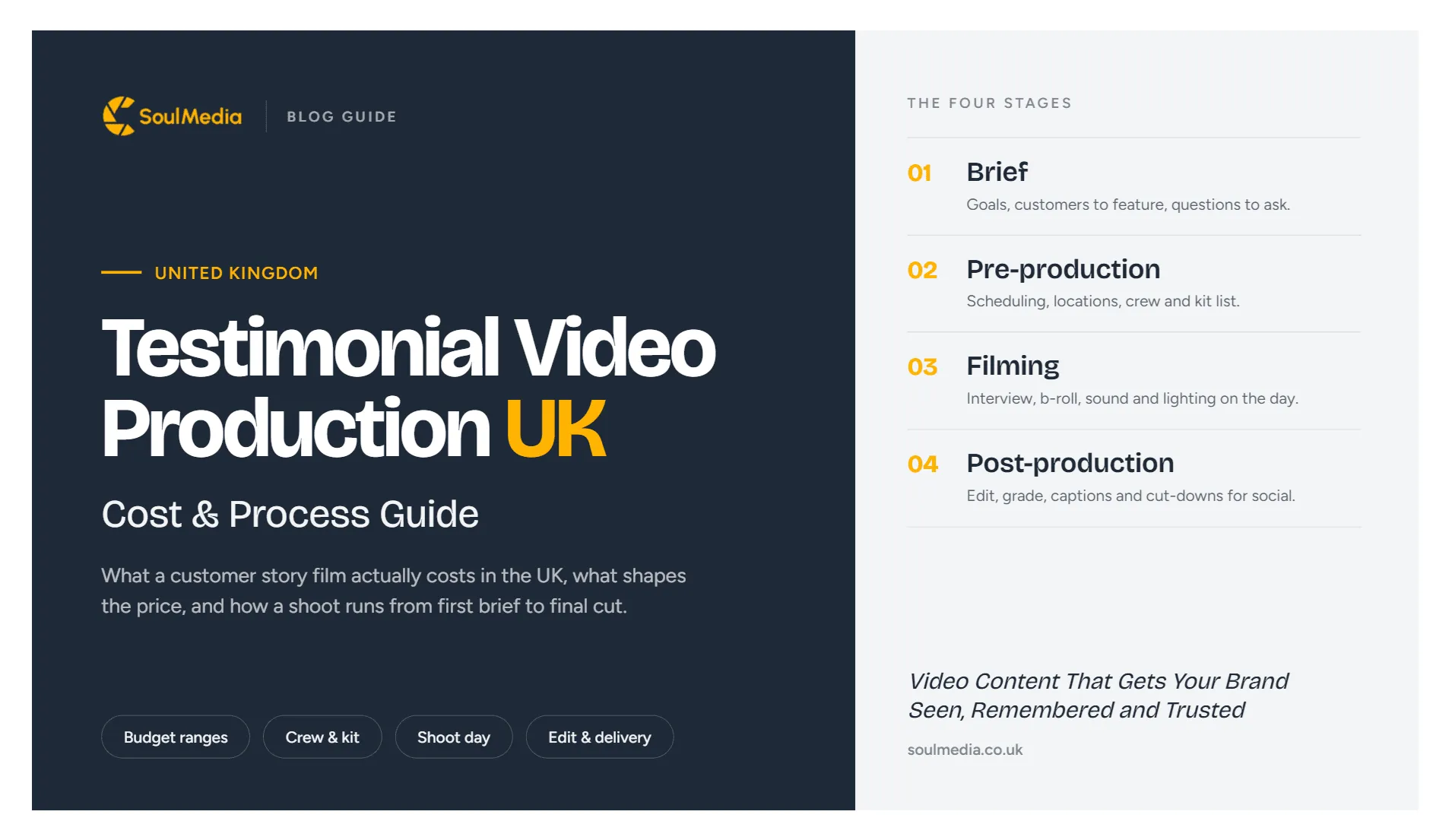
A testimonial video production runs through three stages: discovery and question design, filming, and post-production and delivery, typically wrapping within 10 business days of the shoot for a single-location project.
Discovery and question design happens before a camera comes out. This is where the production team works out which customer to feature, what result you want highlighted, and builds a question list that guides the conversation without scripting it word for word. The goal isn't to write the customer's answers for them; it's to identify the one outcome worth proving before the camera rolls. Skipping this step is the single biggest reason DIY testimonial videos sound stiff; the customer walks in cold and the interviewer improvises.
Filming can happen on location at the customer's premises, in a studio, or remotely for customers who can't be reached in person. On-location filming tends to produce the most authentic footage because the customer is in their own environment, but it also means more setup time for lighting and audio. A well-run shoot rarely takes longer than 45 to 60 minutes of actual interview time, even though the crew may be on-site for half a day accounting for setup and B-roll.
Post-production and delivery is where the raw footage becomes a usable asset: selecting the best answers, cutting for pace, adding lower-thirds and branding, colour grading, and mixing audio. This stage also produces the shorter social cutdowns from the same source footage. Most single-location projects deliver within 10 business days; multi-location or multi-customer projects can take 2 to 3 weeks given the extra footage to review and cut.

Best Questions to Ask in a Testimonial Video Interview
The questions you ask determine whether the finished video sounds like a genuine account or a list of adjectives. The goal is to get the customer talking about a specific before-and-after, not to get them to compliment you.
A question list that consistently produces usable, natural answers looks something like this:
- What was happening before you started working with us, and what made you go looking for a solution?
- What almost stopped you from choosing us?
- What was the moment you knew this was working?
- What's changed for you, specifically, since then, in numbers if you can put a figure on it?
- What would you tell someone who's on the fence about doing this?
Notice none of these ask "what do you like about us?" directly. That question invites a generic answer. Asking about the moment before, the hesitation, and the specific change gets a customer narrating a story rather than reading a rating out loud. It's also worth warming up with two or three throwaway questions that never make the final cut, just to get the customer relaxed and talking in full sentences before the interview properly starts.
Here's what each question is designed to surface:
| Question | What It Uncovers |
|---|---|
| What was happening before you started working with us? | The pain point |
| What almost stopped you from choosing us? | The objection |
| What was the moment you knew this was working? | The turning point |
| What's changed for you, specifically? | The outcome |
| What would you tell someone on the fence? | The advocacy |
How Long Should a Testimonial Video Be?
A testimonial video for a website or landing page works best between 60 and 120 seconds, long enough to tell a real story but short enough that nobody clicks away. Anything filmed for social or paid campaigns should be cut down to 15 to 30 seconds, because attention on those platforms drops off within the first few seconds.
Longer isn't automatically better. A three-minute testimonial rarely gets watched to completion outside of a sales deck context, where a prospect has already opted in to spend time on it. For general marketing use, the discipline is to cut ruthlessly: keep the strongest 90 seconds, and let the social cutdowns carry the rest of the story across other channels.
Where to Use Testimonial Videos After They're Made
A testimonial video earns its budget back by working across multiple channels, not sitting on a single page. The strongest placements are homepages and landing pages, sales decks, LinkedIn and paid social, case study libraries, email campaigns, and trade show loop reels.
Embedding a testimonial directly above the fold on a pricing or landing page tends to reduce hesitation at exactly the point a prospect is deciding whether to fill out a form. In sales decks, a 30-second cutdown dropped into the middle of a pitch does more to defuse objections than another slide of logos ever will. On LinkedIn, a native upload (not a link-out) of a customer talking through a specific result tends to draw noticeably more engagement among B2B audiences than a text post covering the same story. These are exactly the kind of distribution decisions that should sit inside a wider video content strategy rather than being figured out one video at a time.
Filming Testimonials Across the UK, Europe and the Middle East
Filming a testimonial with a customer based outside the UK adds logistics, but not necessarily much extra cost if it's planned as part of the original shoot rather than as an afterthought. Production teams that regularly work across the UK, Europe and the Middle East typically have the workflow to manage travel, local crew coordination and, where needed, multi-language interviews within a single project timeline.
This matters more than it sounds. A UK-based B2B company selling into the Gulf or into mainland Europe often has some of its strongest customer stories sitting with clients who don't speak English as a first language. A testimonial filmed in the customer's own language, subtitled or dubbed for the target market, reads as more credible locally than an English-language original ever will, and it signals to prospects in that region that you already have customers like them. Coordinating that kind of shoot is a different skill set from a single-location domestic interview, and it's worth confirming a production partner has actually done it before committing a multi-country budget to the project.
Consent, Release Forms and Filming Logistics in the UK
Every testimonial shoot needs a signed release form before anything gets used publicly, covering exactly where the footage can appear, for how long, and whether the customer's name, job title and company can be shown alongside it. Get this agreed before the shoot, not after, so nobody is negotiating usage rights while the edit is due.
For UK filming specifically, most of the practical friction is procurement and access rather than anything technical: getting a customer's office or site cleared for filming, working around their internal approval process for external footage, and scheduling around whoever needs to sign off on the final cut on their side. Corporate offices and client sites usually need a few weeks' notice for building access and any internal comms clearance, longer if the customer's own legal or marketing team wants to review the release form.
Data handling is worth a mention too. If the interview touches on customer names, account details or anything that could be considered personal data beyond the interviewee themselves, agree upfront what stays in the edit and what gets left on the cutting room floor.
Testimonial Video vs Case Study Video
A testimonial video is the customer's voice: a short, focused piece built around an endorsement and a specific outcome. A case study video is the customer's story: longer, and built to walk through the problem, the process and the evidence alongside the endorsement.
In practice, the two overlap more than the naming suggests. A single interview shot for a testimonial can supply both: the strongest 60 to 90 seconds becomes the testimonial, and the fuller interview, paired with supporting data or product footage, becomes the case study. If you're choosing between them, use a testimonial when you need a fast trust signal for a landing page or ad, and a case study when a prospect needs to see the mechanics of how the result happened, which matters more for the kind of longer B2B sales cycle also common in corporate video production.
Which Industries and Audiences This Applies To
Testimonial video production earns its keep fastest in industries where trust is the primary barrier to a purchase decision, which covers far more sectors than people assume.
B2B software and SaaS companies use testimonial videos to shorten evaluation cycles, especially when a purchase decision involves multiple stakeholders who each need reassurance before signing off. Professional services firms, including finance, legal and consultancy, rely on testimonials because their product is inherently intangible; a client explaining the outcome of an engagement does more than any brochure describing the process. Healthcare and education providers use testimonials to address the anxiety that comes before a high-stakes decision, whether that's choosing a clinic or a school. Manufacturing and industrial businesses, often overlooked in video marketing conversations, benefit enormously because a plant manager describing a measurable efficiency gain is exactly the kind of peer validation that other plant managers trust. Retail and e-commerce brands use shorter testimonial cutdowns to reduce cart abandonment at the point of purchase. And agencies of every kind use client testimonials as the backbone of new business pitches, because a prospective client hearing a peer describe results is more persuasive than any capabilities deck.
The common thread across all of these is a purchase decision that carries some risk, whether that's financial, reputational, or simply the risk of picking wrong. Testimonial video reduces that risk by proxy.
How to Measure Testimonial Video ROI
Testimonial video ROI is measured in layers, from how many people see it through to how many deals it actually helped close. Tracking all four layers, rather than just view count, is what turns "we made a nice video" into a number a marketing manager can defend in a budget conversation.
Awareness: views, reach and completion rate tell you whether people are watching the whole thing or dropping off early, which usually points to a pacing or hook problem in the edit rather than a topic problem.
Engagement: average watch time and click-through rate from wherever the video is embedded show whether it's doing more than sitting on the page.
Conversion: landing-page conversion rate with the video live versus without it, plus demo requests or enquiries that mention the testimonial specifically, are the clearest signal that it's influencing decisions rather than just being watched.
Sales and commercial impact: sales teams can track how often the video gets used in a deck or shared in a deal, and marketing can tie it to cost per lead, customer acquisition cost, or pipeline it's been attached to, if your CRM supports that level of attribution.
Most businesses only track the first layer. The ones getting real budget for more testimonial production are the ones that can show the last two.
Common Testimonial Video Mistakes to Avoid
Most weak testimonial videos fail for the same handful of reasons, and all of them are avoidable with a bit of planning before the shoot.
Scripting the customer's answers word for word is the most common one. It produces stilted delivery that viewers can spot immediately, even if they can't articulate why. A guided question list beats a script every time.
Choosing the easiest customer instead of the most relevant one is another. A customer who says yes quickly isn't always the one whose story will resonate with your actual target buyer.
Skipping the release form until after the shoot creates unnecessary risk, and occasionally kills a finished video outright when a customer's legal team objects to usage they weren't asked about upfront.
Cutting only one long version and never producing shorter cutdowns wastes most of the value in the shoot; the long-form edit rarely gets watched on social, and cutdowns are usually where the reach actually happens.
And burying the result at the end, rather than opening with it, is the single easiest fix for a testimonial that currently gets skipped past.
Testimonial Video Examples & Case Studies
This section is reserved for real Soul Media testimonial projects and is not yet populated. Publishing placeholder claims here would undercut the credibility this whole guide is arguing for, so nothing goes live until it's backed by an actual client, shoot and result.
What's needed to complete this section: three project write-ups, each covering the client (named, with permission to publish), the challenge that led them to look for a testimonial video, the shoot itself (location, interview approach, languages if relevant), the final deliverables, and the measurable result if one was shared. A useful spread would be one B2B/professional services client, one technology/SaaS client, and one international project across Europe or the Middle East, to reinforce the UK/Europe/Middle East positioning this guide argues for elsewhere.
Final Thoughts
A written review tells a prospect what someone said. A testimonial video lets them watch someone mean it. That difference is a big part of why this format tends to outperform other trust signals, and it's why the businesses getting the most out of it treat testimonial video production as an ongoing part of their marketing, not a one-off shoot before a website relaunch.
The mistake to avoid is treating the interview as an afterthought to the filming. Good lighting and a steady camera get you a professional-looking video. A well-designed question list and a relaxed customer get you one people actually believe. If you've got customers with a strong result to share, whether they're down the road or across the Gulf, get a quote and start with the interview questions, not the shot list.