Social Media Video Production and Brand Storytelling: The Complete 2026 Guide for Growing Brands
TL;DR:
- Social media video production is the process of planning, filming and editing platform-native video (TikTok, Instagram Reels, LinkedIn, YouTube Shorts) that carries a brand's story into people's feeds, not just a single ad cut into five sizes.
- Brand storytelling is the "why," short-form social video is the "where." Businesses that treat them as one connected service, rather than two separate jobs, get more consistent output and a clearer voice across platforms.
- Short-form video (under 60 seconds) is the highest-ROI content format for 2026, and 73% of consumers say they prefer it when researching a product or service.
- A realistic UK budget for a single social video package runs from roughly £800 to £2,500 per video, dropping sharply once you batch several videos from one shoot.
Most companies don't have a video problem. They have a "we posted a video once and nothing happened" problem. That's rarely a camera issue. It's usually a strategy gap between what the brand actually stands for and what shows up in the feed.
This guide walks through what social media video production and brand storytelling actually mean when they're done properly, what the process looks like from strategy call to delivered files, what it costs in the UK in 2026, and where most brands go wrong. It's written for marketing managers, founders and business owners across the UK, Europe and the Middle East who are trying to figure out whether this is worth the spend, and how to brief it properly if it is.
What Social Media Video Production and Brand Storytelling Actually Mean
Social media video production is the filming and editing of short, platform-native video content built specifically for feeds like TikTok, Instagram, LinkedIn and YouTube Shorts. Brand storytelling is the narrative layer underneath it, the "why us" that gives the videos a consistent voice instead of a random string of clips.
People don't follow brands. They follow personalities, opinions and things that feel true. A logo animation doesn't do that. A founder explaining, in their own words, why they started the business does. That's the entire premise behind treating social video and storytelling as one connected discipline rather than a production job handed off after the "real" marketing strategy is finished.
In practice, this covers a fairly wide range of formats: a longer brand story film that anchors an About page or a funding deck, 15 to 60 second cuts built for Reels and TikTok, face-to-camera founder clips, behind-the-scenes culture content, and recurring series that train an audience to keep coming back. All of it should trace back to the same handful of talking points about who the brand is and why it exists. Without that thread, you end up with a content calendar full of unrelated clips instead of a brand people recognise.
Why Video-Led Brand Storytelling Outperforms Traditional Social Content
Video-led storytelling wins because it converts attention into trust faster than static posts or copy-led ads, and the data backs that up hard. Short-form video under 60 seconds is now the format marketers rank as delivering the highest ROI, and it's the only format where engagement is still climbing rather than flattening out.
Wyzowl's 2026 State of Video Marketing research puts real numbers on this: 91% of businesses now use video as a core marketing tool, 85% of people say they've been convinced to buy something after watching a video, and 73% of consumers actively prefer short-form video when they're researching a product or service. Sprout Social's 2026 video benchmarks add a B2B-specific data point that surprises a lot of marketing managers: short-form social video (41%) and brand storytelling (38%) now outrank testimonials (34%) as the video formats B2B marketers say drive the strongest return.
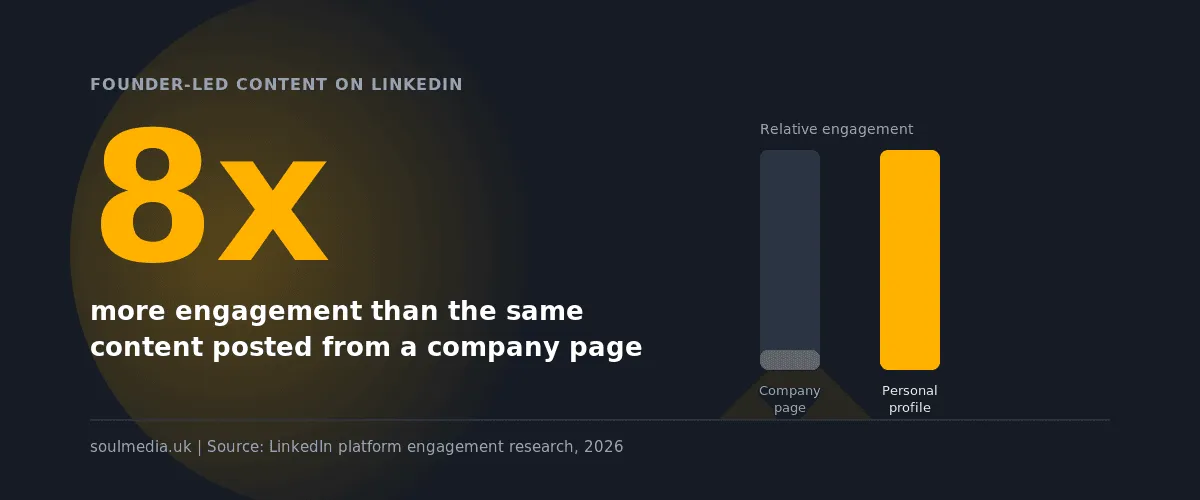
There's also a platform-specific trust signal worth knowing before you brief anything. On LinkedIn, content posted from a personal profile, think founder or team member, not the company page, generates roughly eight times the engagement of the same content posted from the brand account. LinkedIn's own research with Edelman found that 64% of B2B buyers favour thought leadership content over product sheets and sales collateral when they're assessing whether a company knows what it's talking about. If your social strategy is 100% company-page content, you're leaving a lot of reach on the table before a single video gets made.
None of that means every business needs a slick 90-second brand film. It means the format has to match the platform and the goal, which is the part most in-house teams get wrong first.
The Building Blocks: Six Types of Content That Actually Build a Brand on Social
A social media video production service that's worth paying for produces more than one type of asset from a single shoot. Six formats come up again and again across brands that actually build an audience rather than just posting.
Brand Story Films
This is the anchor piece, usually two to four minutes, that sits on an About page, a funding deck or a careers page. It answers "why does this company exist" once, properly, so every shorter cut downstream can reference it instead of re-explaining the brand from scratch every time.
Short-Form Social Cuts
The 15 to 60 second pieces built specifically for Reels, TikTok and Shorts. These are not a long video squeezed to fit a square crop. Each platform gets its own edit, pacing and hook, because the first two seconds behave completely differently on TikTok than they do in a LinkedIn feed.
Founder and Leadership Content
Face-to-camera clips of the person actually running the business. Given the engagement gap between personal and company-page content on LinkedIn, this is often the single most valuable format for a B2B or professional-services brand, and it's also the format most founders are the most reluctant to film. That reluctance is usually the biggest thing standing between a brand and its best-performing content.
Behind-the-Scenes and Culture Content
Unscripted, lower-production clips that show the team, the process, the workspace. These do double duty: they humanise the brand for customers and they're some of the highest-performing content for hiring and retention, since candidates increasingly judge a company by its social presence before they ever apply.
Series and Episodic Formats
A recurring format, released on a schedule, that trains an audience to expect and return for the next instalment. This is where a lot of the compounding value sits. One-off videos get one spike of attention. A series builds a habit.
Platform-Native LinkedIn Video
LinkedIn specifically rewards native upload over a shared link from another platform, and its algorithm treats video differently to how Instagram or TikTok treat it. A video built and uploaded natively for LinkedIn, rather than repurposed from Instagram, consistently outperforms the repurposed version on that platform.
Platform-by-Platform: What Actually Works Where
Format, length and tone need to change by platform, because each one rewards a different kind of first two seconds and a different level of polish. Treating TikTok, Instagram, LinkedIn and YouTube as one interchangeable output is the fastest way to underperform on all four at once.
| Platform | Best format & length | What performs | Tone that works |
|---|---|---|---|
| TikTok | 15-45 sec, native vertical | Fast hook, trend-aware cuts, founder/team faces | Raw, unpolished, personality-led |
| Instagram (Reels & Feed) | 15-60 sec Reels + polished Feed posts | Aesthetic consistency, carousel-adjacent storytelling | Slightly more produced than TikTok |
| 30-90 sec, native upload | Founder/leadership talking points, thought leadership, BTS | Professional but human, not corporate-read | |
| YouTube (Shorts & long-form) | Shorts 15-60 sec, long-form 3-10+ min | Shorts for discovery, long-form for depth and SEO | Explainer-driven, higher production value |
The practical implication: one shoot day should be scoped to produce multiple platform-specific cuts, not one video repurposed four ways. That's also why a single half-day shoot typically yields one long-form brand story piece plus six to ten short-form cuts, rather than a single asset.
How a Social Media Video Production Agency Actually Works, Step by Step
A properly run social video production process has five stages, and skipping the first one is where most wasted budget comes from. The process starts with strategy, not a camera.
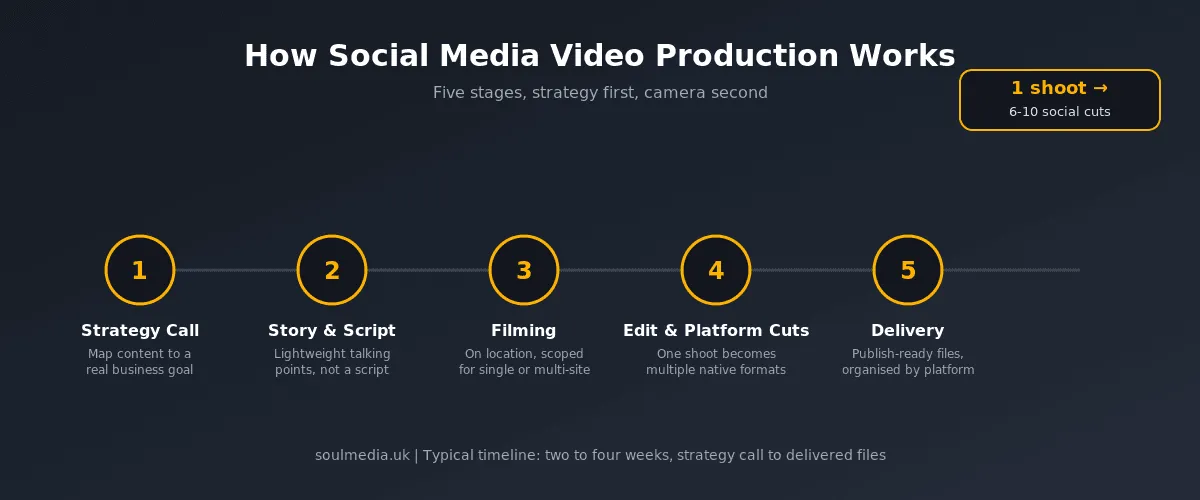
- Strategy call. Content gets mapped to an actual business goal, awareness, hiring, trust-building or lead generation, rather than a generic shot list. This is the stage that determines whether the finished videos have a job to do.
- Story and script. A lightweight talking-points brief, not corporate-read copy. Founders and team members speak in their own words; the brief exists to keep them on-topic, not to hand them a script to memorise.
- Filming. On location, scoped the same way whether the shoot is in London or across a team's offices in Europe or the Middle East. Multi-location shoots need the same strategy-first approach as a single-site shoot, just with more logistics planning upfront.
- Edit and platform cuts. One shoot becomes multiple formats, captioned and cut specifically for where each piece will run.
- Delivery. Files organised by platform, ready to upload, with nothing left for the internal team to re-edit before it goes live.
Picture a 40-person SaaS company preparing for a funding round. A single half-day shoot with the founder and two team leads, planned around the "why we built this" narrative from the strategy call, can realistically produce one anchor brand story film for the pitch deck and About page, four or five LinkedIn-native founder clips, and a handful of TikTok/Reels cuts for hiring content, all from the same four hours of filming. That's the payoff a properly scoped process creates versus booking a videographer with no strategy call first.
What Social Media Video Production Costs in the UK (2026 Pricing Breakdown)
UK social media video production typically runs from around £800 to £2,500 per video for a single short-form package, with meaningful discounts once you batch multiple videos from one shoot. Pricing scales with shoot complexity, number of locations and how many platform-specific cuts you need from the same footage.
| Package type | Typical UK price range (2026) | What's usually included |
|---|---|---|
| Single short-form video | £800-£1,500 | One platform cut, basic captions, one location |
| Batched shoot (3-5 videos) | 20-30% discount vs. single-video rate | Multiple platform cuts from one shoot day |
| Half-day brand story shoot | From £1,000 | One anchor film + short-form cuts, one location, limited revisions |
| Full-day multi-format shoot | From £2,499 | Two locations, more revisions, broader format mix |
| Multi-day / premium production | £4,999+ | Unlimited revisions, raw footage included, larger format spread |
Two things push costs up fast: shooting across multiple locations or countries, and asking for a heavy revision cycle after the edit is delivered. Both are worth clarifying at the strategy-call stage, not after a quote lands, because they change the shoot plan itself, not just the invoice.
Real Scenarios: How Different Businesses Actually Use This Service
The specific mix of formats changes a lot depending on what the business is trying to achieve, which is easier to see through a few grounded, illustrative examples than through a generic feature list.
Consider a family-run restaurant group expanding to a second location. Their priority isn't brand philosophy, it's local footfall and hiring kitchen staff who actually want to work there. The right mix leans heavily on behind-the-scenes culture content and short, appetite-driving Reels and TikToks, with the founder appearing occasionally to put a face to the name, rather than a polished brand story film sitting unused on a rarely-visited About page.
Now take a 15-person professional services firm, an accountancy or a boutique law practice. Their buyers research quietly and trust matters more than reach. Founder and partner-led LinkedIn video, filmed natively rather than repurposed from Instagram, tends to do the heaviest lifting here, supported by a single anchor brand story film that explains the firm's approach once, properly, for the website and pitch materials.
Then there's a mid-size events and conference organiser trying to prove ROI to sponsors ahead of next year's renewal. The priority is a fast-turnaround highlight edit from the event itself, cut for LinkedIn and Instagram within 24 to 48 hours, backed by a small library of founder or organiser clips that build credibility with sponsors browsing the brand's channels between events.
Three different businesses, three completely different format mixes, all built from the same underlying process. That's the point of running a strategy call before anyone picks up a camera.
Common Mistakes Brands Make With Social Media Video
The most expensive mistake is skipping strategy and going straight to filming, because it produces content with no job to do and no way to measure whether it worked. A few others show up constantly:
- One video, five platforms. Cropping a single edit to fit TikTok, Reels, LinkedIn and YouTube Shorts instead of cutting each one natively. The hook that works on TikTok usually falls flat on LinkedIn.
- Scripted founders. Word-for-word scripts read on camera, rather than a loose talking-points brief. Audiences can tell the difference immediately, and it undercuts the exact authenticity that makes founder content work.
- No posting cadence. A brilliant one-off video with no series or follow-up plan behind it. Single spikes of attention don't compound the way a recurring format does.
- Company-page-only distribution. Especially on LinkedIn, where personal-profile content consistently outperforms the same content posted from the brand page by a wide margin.
- No goal attached to the shoot. Filming "some content" rather than content mapped to hiring, awareness, trust or leads. Without a goal, there's no way to judge whether the video worked.
How to Choose a Social Media Video Production Partner
Look for one team that owns strategy, filming and editing together, rather than three separate freelancers handed off in sequence, because that's usually where briefs get lost and timelines slip. A few practical questions to ask before committing: does the quote come from a strategy call or a flat day rate, how many platform-specific cuts come from a single shoot, what's the realistic turnaround from filming to delivered files, and is pricing transparent enough to see before you get on a call. Two to four weeks is a realistic end-to-end timeline for most projects, from the first strategy call to delivered, publish-ready files.
Which Industries and Audiences This Applies To
This service earns its budget fastest for businesses where trust, personality or fast-moving content actually changes buying or hiring decisions. In practice that covers a fairly specific set of businesses rather than "everyone."
Hospitality and restaurant groups use it for local footfall, seasonal menu launches and kitchen-staff hiring content. SaaS and tech startups lean on founder-led LinkedIn video ahead of funding rounds and product launches, where investor and buyer trust hinges on the person behind the company. Professional services firms, accountancy, legal, consulting, use it to humanise a traditionally text-heavy, low-trust-by-default sector. Franchise and multi-location retail brands need a repeatable content system that keeps a consistent voice across locations without re-inventing the brief every time. Events and conference organisers use fast-turnaround highlight edits to prove ROI to sponsors and exhibitors between events. E-commerce and DTC brands rely on short-form product and founder content to compete in feeds where static product shots increasingly get scrolled past. Nonprofits and mission-led organisations use brand story films and behind-the-scenes content to build the kind of donor and volunteer trust that a fundraising email alone can't.
Final Thoughts
The brands that actually build an audience through social video aren't the ones with the biggest budget. They're the ones who treat storytelling and production as one job instead of two, brief a strategy call before anyone books a camera, and accept that a founder talking honestly to a phone camera will usually outperform a scripted, over-produced brand ad. If your current social content feels like it's not working, the fix is rarely "post more." It's usually "post the right format, on the right platform, tied to an actual goal." Start with a strategy call, not a shot list, and the rest tends to follow.
Ready to see what this looks like for your brand specifically? Get a scoped quote or browse recent work before you get on a call.